♪ Intuitive Singing • Core Sounds • Timbre

People think that to sing you need to "do something special" to your voice

But it's actually the opposite…

Intuitive Singing logo

From birth, your voice already contains core (natural) sounds. When you switch them on, your voice starts sounding natural immediately.

And you don't have to "force" it or rebuild your voice into a "singer mode".

Because these core sounds work the same in speech and in singing.

When I realized this, I was able to discover and articulate an astonishing principle for working with the voice.

The principle is about drawing out your natural sound through core sounds that instantly open the door to singing songs.

After that, your voice "switches on" — without extra theory or classical drills.

Aleksandra Stroitseva

Vocal methodologist. Certified specialist (Schnittke Institute; Gnessin Academy).
Creator of the show "Battle of Vocalists" and the celebrity podcast "Sing & Live Beautifully".
#1 vocal blogger in the Russian-speaking world by total audience size.
Author of the books "INTUITIVE SINGING: How to Reveal Your True Timbre at Any Skill Level" and "The Vocalist's Handbook" (EKSMO publishing).

Method photo

You don't have to "squeeze out" a singing tone

What used to require long practice now turns on naturally.
Because at the core level, the voice has already found the right sound.

"

First you find this core sound. It's primal, powerful, bright — but still a little "raw".

Then you refine it. With specific emotions and a training syllable, you shape the sound into the final result.

The algorithm is crystal clear:
1

Choose one of the three core sounds

A raw, powerful, natural sound — the base of your timbre.

2

Add a specific emotion

Emotion gives timbre color — without it, the voice loses its individuality.

3

Add a special training syllable

The syllable helps the sound "lock in" and become stable and controllable.

4

Pick a vivid phrase from a song and turn it into an exercise

At this stage you're already singing with the technique — it's built into your sound.

This is where your own timbre starts to switch on, because:

• You connect your sounds and your emotions

• In the end you get a finished vocal technique in your own timbre — naturally, without tension, skipping dozens of hours of routine drills.

Unlocks the "Core Sounds" section

Here's what it looks like in practice:

At first you sing weird sounds…

…and then your voice switches on

Here's what happens with beginners…

…and here's how it looks for continuing students

Did you hear the difference? These results in such a short time are insane 🙏

You can check real reviews here.


Why this method is especially important for Russian-speaking teachers

The classical approach 👇

Classical approach diagram

Common problems

1

It doesn't work with timbre

So the voice can't open up 100%. Individuality and timbre don't show up in songs.

2

The focus shifts to drills

More time goes to classic exercises, leaving too little time for actual songs.

3

Hard to move from exercises to songs — a barrier appears

Everything done in exercises is difficult to transfer into songs. "Training exists separately from songs."

The Intuitive Singing method 👇
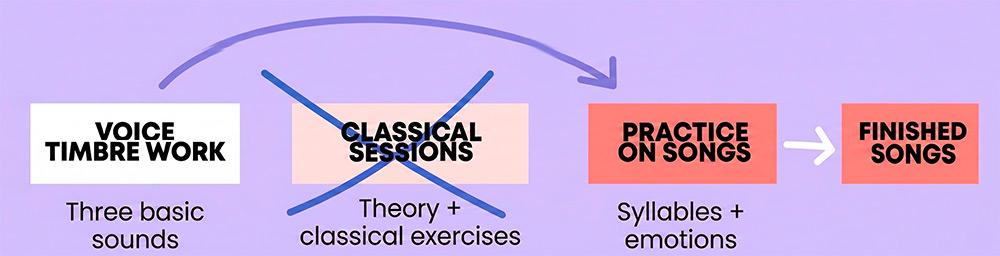
Intuitive Singing method diagram

Opens the voice wider and gets you to songs faster

1

Starts by unlocking timbre

We begin with the 3 core sounds that раскрывают inner potential, individuality, and timbre.

2

Practice directly on songs

We choose a vivid phrase from a song. With special syllables and emotions, we immediately connect the needed techniques.

3

No barrier between drills and songs

All training follows one rule: take core sounds and plug them straight into a song.
What stops you from singing

(Clip from "Core Sounds — Deep Voice Tuning")


Top Western approaches 👇

(Clip from the course "Foundations of Modern Vocal")


The method is split into 2 stages

1) Foundation (Deep Voice Tuning)

In the foundation stage we раскрываем 3 core sounds. This gives your voice a solid base, releases tension, opens up timbre, and helps you understand how to control your voice.

Unlocks the "Core Sounds" section

2) Vocal Techniques

Brings your voice to a professional level. We master 7 key vocal techniques that help you sing almost any song: mix, belting (powerful high notes), nasal & laryngeal twang (dense midrange), sub-tone (velvety lows), falsetto (volume & ease) + runs, edge (bright timbre).

Only recently I truly realized that I created something genius and simple. Yes — I say it that boldly. And I have reasons.

🤔 What it's about:

Deep voice tuning rests on 3 main sounds.

And if you haven't found them, the voice starts to "glitch" — it won't obey.

These sounds are so natural and simple that a few exercises are often enough — and everything "switches on".

Like the three primary colors — red, blue, and yellow — that create the whole palette. Same with the voice: there are 3 "deep" core sounds.

Tension, discomfort, flat sound, nasality, "choir" tone, overly heady sound — all of this is regulated by these core settings.

My "Intuitive Singing" method is built on these 3 pillars — and yes, it's damn genius — because it's simple and accessible.

We all could do these sounds as kids, when we were free — but over time we buried them deep inside.